Showing posts with label Afghanistan Medal. Show all posts

12 February 2014

Dixons Gazette 77 - due soon


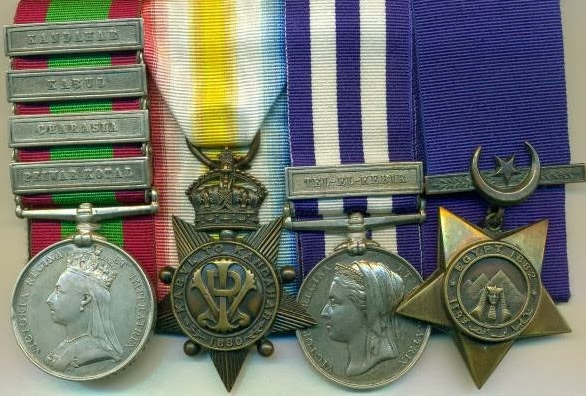
I love these multi-campaign groups and this one, albeit missing its LSGC, would be a good one to own.  It's currently up with Dixons for £1800. The write-up reads:
 
"William James Smith...  was born in the Parish of St. Martin-in-the-Fields, Middlesex [and]originally enlisted in the 54th Foot in September 1870, aged 24 years. Subsequently advanced to Armourer Sergeant, he transferred to the 72nd Highlanders in February 1877 and witnessed active service in India and Afghanistan, October 1871-August 1882 and in Egypt, August-October 1882..."
 
Dixons' next catalogue is due out soon.


29 August 2011

Defence of Kelat-i-Ghilzie Medal


Instituted:
Sanctioned by a General Order from Simla, India dated 4th October 1842.

Qualification:
Awarded to the Garrison at Kelat-i-Ghilzie, Afghanistan which was commanded by Captain John Halkett Craigie. The Garrison withstood a four-month siege until relieved in May 1842.

Description:
Silver, 36mm diameter. The obverse (above) portrays a shield with the words KELAT-I-GHILZIE whilst the reverse (below) depicts an assortment of military trophies and the inscription INVICTA MDCCCXLII. The medal was designed by William Wyon RA.


Ribbon:
41mm wide, rainbow pattern of red, white, yellow, white and blue.

Suspension:
Steel suspender and clip.

Naming:
Engraved in script along the edge.

Clasps:
None.

Acknowledgements:
British Battles and Medals for the history of the medal, Dix Noonan Webb for the images used in this post.


Ghuznee Medal - The Earl of Auckland's Medal

Completing a trio of posts which include the actions at Ghuznee in Afghanistan in 1839 is this special Ghuznee Medal presented by the Rt Honourable The Earl of Auckland in his capacity as Governor-General of India.

British Battles and Medals does not indicate how many of these medals were issued, although the infrequency with which they appear at auction suggests that they are scarce. I have been unable to find a suitable image online.

Qualification:
Presumably, officers and men involved in the capture of Ghuznee, Afghanistan in March 1839.

Description:
Silver, 41mm diameter. The obverse is similar to the official Ghuznee Medal and was presumably modelled on it. It depicts the fortress of Ghuznee with the British Army entering through the main gate. The reverse has the words AFGHANISTAN - GHUZNEE - 23RD JULY 1839 inscribed on three lines; the whole enclosed within two laurel branches.

Ribbon:
None.

Suspension:
None.

Naming:
Issued unnamed.

See also:

Ghuznee Medal
Candahar, Cabul and Ghuznee Medals


26 August 2009

Kabul to Kandahar Star


Instituted:
Authorised on 19th March 1881.

Qualification:
It was awarded to all those who took part in General Roberts’s three hundred mile march from Kabul to Kandahar between 9th and 31st August 1880.

Description:
A five-pointed star with a ball between all of the points except the two uppermost where a crown is fixed. The obverse has the mongram VRI in the centre. Around the border is KABVL TO KANDAHAR and the date 1880 at the bottom. The reverse is plain except for naming in the hollow centre (see below). Designer unknown; manufactured by H Jenkins & Sons of Birmingham.

Ribbon:
38mm wide and a rainbow pattern of red, white, yellow, white, blue.

Naming:
Indented capitals to British troops; engraved in capitals and script to natives.

Clasps:
None issued.

Other:
The Kabul to Kandahar Star was usually issued with the Afghanistan Medal (with Kandahar clasp) and was made from guns captured from the army of Ayub Khan.

Errors in naming to Foot instead of Regt have been found (Childers' 1881 reforms saw the old Regiments of Foot giving way to new County Regiments).

Photo:
Image borrowed from the Dixons Medals website.
20 August 2009

Afghanistan Medal


Instituted:
Authorised on 19th March 1881.

Qualification:
Awarded to all those who took part in the Afghanistan campaigns of 22nd November 1878 to 26th May 1879 and 3rd September 1879 to 20th September 1880.

Description:
Silver, 31mm diameter with plain, swivelling suspender. The obverse portrays the crowned and draped head of Queen Victoria and the legend VICTORIA REGINA ET IMPERATRIX. The reverse (above) depicts marching and mounted troops and an elephant carrying a cannon. The word AFGHANISTAN appears around the top, and the dates 1878-79-80 at the bottom. The obverse was designed by J E H Boehm and the reverse by R Caldecott.

Ribbon:
Green with crimson stripe on each edge.

Naming:
A variety of different styles. Medals to British troops were engraved in upright or sloping capitals whilst those awarded to natives are found in capitals or script.

Clasps:
Six bars were issued and these are listed below.

1. Ali Musjid
Awarded for the action of 11th July 1882.

2. Peiwar Kotal
Awarded for the action of 2nd December 1878.

3. Charasia
Awarded for the action of 6th October 1879

4. Kabul
Awarded for those involved in operations at or near Kabul between 10th and 23rd December 1879, including the column under Brigadier General C J S Gough which joined Sir Frederick Roberts VC on 24th December that year.

5. Ahmed Khel
Awarded for the action of 29th April 1880.

6. Kandahar
Awarded for the action of 1st September 1880 and also to those who took part in the reconnaissance of the city the previous day but who did not take part in the attack.

Other:
Sixteen Victoria Crosses were awarded for valour during the Afghan campaign and five generals who were VC holders also took part in the campaign.

The Kabul to Kandahar Star was usually issued with the Afghanistan Medal (with Kandahar clasp) and was made from guns captured from the army of Ayub Khan. It was awarded to all those who took part in General Roberts’s three hundred mile march from Kabul to Kandahar between 9th and 31st August 1880.

Photo:
Image borrowed from the Dixons Medals website.