Showing posts with label WW1. Show all posts

11 September 2014

Military Medals of the First World War

 
Military Medal - Bravery in the Field
 
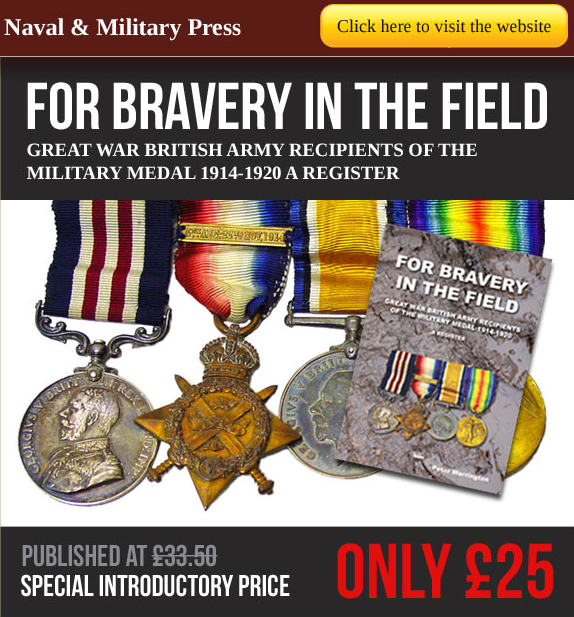
Here's the latest Naval & Military Press release for those with a World War One or medal interest: Great War British Army recipients of the Military Medal 1914-1920. This is a big book and now would be the time to buy it at this special introductory price. Click on the link or the images to go straight to the Naval & Military Press website.

Great War Military Medals 1914-1920


7 April 2012

Lost Medals Australia


An honourable mention here to Lost Medals Australia and the associated Lost Medals Australia blog. Run by Lt Col Glyn Llanwarne, Lost Medals Australia has, since 2000, been returning lost medals to veterans or their families. This is a free service supported through donations of 'found' medals.  To date, an impressive 1111 medals have been returned.

The image on this post has been taken from the Lost Medals Australia blog and the fascinating story of the return of a First World War pair owned by a former mayor of St Kilda. Well done, Glyn, and thanks for following this blog.

6 April 2012

203507 Pte L A Harris, Essex Regiment


I picked up the Victory Medal to this man about eighteen months ago; part of a job lot from the second-hand market in Chelmsford.  I wrote about Stephen Smeeton - another component of the job lot - yesterday.  This is Leslie Harris's story.

The medal index card gives this man's name as Leslie, and little else.  He was entitled to the British War and Victory Medals and so did not arrive overseas until 1916 at the earliest.  His number - 203507 - belongs to the series allocated to the 4th Battalion, Essex Regiment, and I know from my own research into army numbers that this number was not issued until after May 1917. 

There are surprisingly few candidates for Leslie A Harris recorded in the GRO's birth records. The most compelling candidate appears to be Leslie Arnold Harris who was born in Godmanchester, Huntingdonshire and who appears on the 1911 census as a 12-year-old living with his family at 64 Salisbury Avenue, Rochford, Essex.  This would have made him an 18-year-old conscript in 1917.

The owner of my Victory medal certainly survived the war and, I believe, died in 1961.  There is a death for a 61-year-old Leslie A Harris recorded in the Brentwood District in the June quarter of that year.

Cap badge courtesy of North-East Medals.

5 April 2012

B-2966 Pte S S G Smeeton, Rifle Brigade


I picked up this man's Victory Medal some while back and thought it might be an idea to post what I know about him.  His medal index card tells us the following:

1. He was entitled to the 1914-15 Star, the British War Medal and the Victory Medal
2. He was awarded silver war badge number 151770 which was mislaid, was found by the police,returned to him and subsequently acknowledged on the 20th June 1917
3. He arrived overseas in France on the 21st July 1915
4. He was a corporal when he stepped off the boat in France but was subsequently reduced in rank
5. He must have been discharged from the army prior to 20th June 1917 (see 2. above)
6. His British War Medal was incorrectly impressed and was returned on the 18th February 1921.  It was re-issued on the 21st December that year.

No service record survives for this man but the B prefix indicates that this man was either a reservist whose number had been re-allocated (which, incidentally, according to Queen's and King's Regulations, it shouldn't have been) or a time-expired regular who was re-enlisting.  I could find no surviving service record in WO 97 but his silver war badge roll entry confirms that he enlisted on the 1st September 1914 and was discharged on the 20th March 1917 as a result of wounds (rather than sickness).

A search through birth records yields one candidate: Stephen Samuel G Smeeton whose birth was registered in the West Ham district in the September quarter of 1885.  I have not located him on either the 1891 or 1901 census returns but he appears on the 1911 census as a 25 year-old stevedore living with his parents and five siblings at 68 Canton Street, Poplar.  A widowed sister-in-law, Bertha Kershaw, is also recorded and it is noted that his mother had given birth to eleven children, nine of whom were still living in 1911.  Stephen is recorded on the census as Stephen S J Smeeton and he is the only child who is recorded as having been born in West Ham.  The next youngest sibling is Albert James Smeeton aged 20, and therefore born around 1890, whose place of birth is noted as Poplar.  Presumably then, the family moved from West Ham to Poplar at some point between 1885 and 1890. Stephen is the only member of the family noted at that address on the 1915 electoral roll.

As regards Stephen's military service, let's assume he joined the army at the age of 18.  This would have made his year of enlistment as 1903 and a time when general short service enlistment terms were three years with the colours and nine on the reserve.  So perhaps he served until 1906 and was on the reserve when war was declared.  This doesn't seem right to me - his date of entry into France seems just too late for a much-needed reservist - but I'll have to content myself with this mystery in the absence of documentary evidence to the contrary.

The year after he was discharged from the army, Stephen Smeeton married Gwendoline E E Hiorns in Hackney.  Their marriage was recorded in the September quarter of that year. He and Gwendoline appear on the 1919 and 1920 electoral rolls living at 167 Mandeville Street, Hackney but by 1922 Stephen is living at 50 Spring Lane, Stamford Hill (Gwendoline does not appear) and he's still there, alone, in 1923 and 1924.  As well as confirming Stephen's address, the electoral rolls also give us his full name: Stephen Samuel George Smeeton.

I could find no evidence of issue from Stephen's marriage to Gwendoline Hiorns and after 1924 the trail goes cold until 1937 when Stephen Smeeton's death at the age of 51 is recorded in the registration district for Ongar, in Essex.

6 December 2011

WW1 Campaign Medals - dates of issue


The following information, in much abbreviated form, is taken from Howard Williamson's, The Great War Medal Collectors' Companion:

1914 Star
Issued as a single medal from January 1919 to October 1920
Issues of the 1914 Star Trio between November 1920 and end of 1922, with late issues from 1923

1914 Clasp and Roses
Main issue dates between January 1920 and July 1921
Issued with Trios from November 1920

1915/15 Star
Issued as a single medal from January 1920 to September 1920
Issues of the 1914/15 Star Trio between October 1920 and 1926, barring late issues

British War Medal & Victory Medal
First issues mainly to 1914 and 1914/15 Star recipients.  Trio issues, see dates above.
Majority of pairs issued between November 1920 and December 1927

Territorial Force War Medal
Majority issued between 1922 and 1926

MID Emblems
Majority despatched between April 1920 and May 1921
Incorporated with 1914 Star Trios from April 1920 and 1914/15 Star Trios from July 1920

The above information may be helpful in dating photographs of service personnel wearing a single 1914 Star (with or without clasp) or 1914/15 Star; similarly photos of men wearing just the ribbon for these medals. 

16 June 2009

1914-15 Star


Authorised:
1918.

Qualification:
First World War. Officers and men of British and Imperial Forces who served in any theatre of war between 5th August 1914 and 31st December 1915, but excluding those officers and men who were already entitled to receive the 1914 Star. No bars were issued for this medal.

Description:
The 1914-15 Star is similar to the 1914 Star. A bronze four-pointed star design, Wikipedia gives the dimensions as 50mm high and 45 mm wide. Obverse; the upper point is replaced with a crown and solid fixed suspension ring. Two crossed short swords are positioned between the arms of the star and a scroll, longer than that on the 1914 Star, and bearing the date 1914-15 passes around the centre of the swords. The central area is surrounded by an oak wreath bearing a King George V (GV) monogram on the lower point. Reverse: plain. Recipient’s details impressed on the reverse.

Ribbon:
Red white and blue in shaded and watered stripes. The same ribbon is used for the 1914 Star.

Naming:
Impressed in sans- serif capitals.

Other:
In total, around 2, 366,000 1914-15 Stars were issued. Men serving during WW1 and qualifying for this medal were also entitled to the British War Medal and Victory Medal.

The image above shows the 1914-15 Star court-mounted trio awarded to 236418 Sapper Henry Peirce of the Royal Engineers.


11 June 2009

Citations of the DCM 1914-1920


Citations of The Distinguished Conduct Medal in the Great War 1914-1920

The Naval & Military Press has this to say about this four volume set:

"This much-needed series lists the full citations of the Distinguished Conduct Medal (and second and third award bars) in the Great War. The DCM may not have the cachet of the VC, but the deeds told in the citations for the award are just as heroic and inspiring.

"Section 1 of the series lists DCMs won by members of the Royal Flying Corps and (from April 1918) of the Royal Air Force; the Foot Guards; and the Yeomanry and Cavalry. Section 2 covers the Line Regiments. Section 3 the Territorial Army Regiments including the RGLI/RNVR/RMLI and RMA; the Royal Engineers and the Royal Artillery. Section 4 covers the Corps and the overseas forces of the Crown in alphabetical order: Australia; the British West Indies Regiment; Canada; India; Newfoundland; New Zealand; Rhodesia; South and East Africa.

"The citations for DCMs are hard to find - unit histories often have no space for more than a brief mention; or just the bare fact of the award tucked away in an appendix. Others are lost in the labyrinth of small print in the official ‘London Gazette’. But, thanks to the research of Rob Walker, who compiled the citations, and the tireless work of Chris Buckland who oversaw the mammoth task of typing of all 25,000+ citations, the brave deeds which won the medals are here for all to see."

3 June 2009

G/1559 Private Edward Plumridge, 8th East Kent Regt (The Buffs)


Medals held:
1914-15 Star, British War Medal, Victory Medal.

Edward Plumridge was a Kitchener volunteer who joined up in early September 1914 and lost his left leg a year later as a result of being wounded at the Battle of Loos. This is his story.

Edward was born at Bradenham, near High Wycombe in Buckinghamshire in 1883. He was the son of Frederick and Sarah Plumridge and when the 1891 census was taken, was living with them in Bradenham. The household comprised, Frederick (head, aged 50, an agricultural labourer), Sarah (aged 40) and four children: Minna Plumridge (aged 11), Gertrude Plumridge (aged nine), Edward (aged seven) and Reginald Plumridge (aged three). The children and their mother had all been born at Bradenham but Frederick is recorded as having been born at Boullen End, Bucks.

Frederick does not appear with the family on the 1881 census but his wife is noted on it as a lace beader and she was living in Bradenham village with her 75 year old widowed father, Thomas Plumridge, and her one year old infant, Minna. Frederick may have been a patient in All Saints Convalescent Hospital, Eastbourne at the time. A married, 42 year old Buckinghamshire-born man by that name was certainly there in 1881, giving his place of birth as Poges and his occupation as railway plate layer.

In any event, by 1901 the family had somewhat dissipated. Sarah is recorded as a 50 year old widow on the census that was taken that year, visiting Henry and Sarah Wooster at their house in Bradenham. Minna had moved to London and was working as a 21 year old nursemaid for solicitor Henry Rawstone and his wife Madeleine in their home at 65 Queen’s Gate, Kensington, and I have been unable to trace Edward, Frederick or Gertrude.

Thankfully, Edward’s army service record survives in the WO 364 pension series so we are able to see that he attested with the East Kent Regiment at Battersea, London on 8th September 1914. He stated his profession as a male attendant at Tooting Bec Asylum and his age was noted as 30 years and 291 days. Edward had a sallow complexion, blue eyes and light brown hair. He was five feet, five and a half inches tall and weighed 132 lbs. Four days later, Edward was posted to the 8th Battalion and promoted lance-corporal at the same time. He then remained in England until 31st August 1915 when he arrived in France, being promoted to corporal on the same day. He would not retain his stripes for very long.

A note on Edward’s service record for 16th September 1915 reads, “In confinement awaiting trial by FGCM [Field General Court Martial]. When on active service disobeying a lawful command given by his superior officer. Sentence guilty. Reduced to the Ranks. Confirmed by Brig Gen commanding 72 Bgde.”

Edward returned to his battalion and was wounded and gassed at the Battle of Loos twelve days later. His service record states G[un shot] W[ound] leg & Gas. Next to the line, Effects of Wounds, is written simply, amputation. Rushed into action on the 26th September after lengthy forced marches, the division suffered terribly at Loos, Edward being one of more than 3,900 casualties.

On 10th October 1915, a telegram was sent from No 5 General Hospital Rouen stating that Edward was dangerously ill and that his relatives should be informed. He recovered sufficiently though to return to England 16 days later on the Hospital Ship George.

Edward would have been a stretcher case and appears to have been taken straight to the 3rd London General Hospital, Wandsworth where he remained until 23rd March 1916. On his discharge from hospital he signed for one ankle boot, one cap, two pairs of woollen drawers, one jacket, one pair of puttees, one pair of service trousers, one waistcoat, one great coat, one kit bag, one pair of braces, one cap comforter, three shirts and three socks.

Edward returned to Bradenham until 14th August 1916 when he was admitted to Roehampton Hospital in London for the fitting of his artificial leg. He appeared before a medical board at The King George Hospital, Stamford Street, south east London (a clerk noting his name incorrectly as Edwin) and he was discharged from the army two weeks later on 7th October. He then appears to have spent time in a convalescent home in Devon (105 Barton Road, St Thomas’s, Exeter) and was certainly at that address on 15th October, writing to the officer in charge of records at Hounslow that he would like a silver war badge. This was duly sent to him (badge number 59999) on 4th December that year.

On 29th October 1916, Edward was awarded a pension of 25/ a week for two months and then 12/6 per week for life. He received his King’s discharge certificate on 22nd July 1918 and on 14th June 1920 was living at 113 Tooting Bec Road, Balham, London SW17.

Edward’s 1914-15 Star is inscribed to G-1559 L-Cpl E Plumridge, E Kent R (indicating that he must have been promoted after he set foot in France). His BWM and VM are inscribed to G-1559 Pte E Plumridge, E Kent R. His silver war badge is not in my possession.
Sub Conductor George A J Welch, Indian Army Ordnance Corps, formerly Yorkshire Regiment


Medals held:
Queen's South Africa Medal and three clasps (Cape Colony, Orange Free State, Transvaal), King's South Africa Medal and two clasps (1901, 1902), 1914-15 Star, British War Medal, Victory Medal, Delhi Durbar Medal 1911, Military Long Service and Good Conduct Medal.

George A J Welch was born in Allahabad, India around 1880 or 1881. He appears on the 1891 census as a ten year old scholar; the eldest child of James and Lily Welch. James Welch, born at Shepton Mallet in Somerset, is recorded as a 39 year old quartermaster sergeant serving with the Yorkshire Regiment. His wife Lily is recorded as 31 years old; a British subject born in Burma. Apart from George, the other children are noted as John L Welch, a seven year old scholar born at Netley, Hampshire; Frederick H D Welch, a four year old scholar born at Richmond, Yorkshire; Thomas R Welch aged two, also born at Richmond; and Louisa M L Welch aged one month, born at Richmond. At the time the census was taken, the family was living at Allen Place, Richmond.

Neither George nor John appear on the 1901 census (both were away fighting the Boers in South Africa). The rest of the family though - including two additions - had moved to Potternewton in Leeds and was living at 18 Leopold Square. The household comprised James (head, aged 49, recorded as an army storekeeper and noted by the census takers as an army pensioner), his wife Lily (aged 41, this time recorded as having been born in India), and the couple's five children. They were: Frederick Welch aged 14, Thomas Welch aged 12, Louisa Welch aged 10, Isabelle Welch aged seven, and Herbert Welch aged five. Both Isabelle and Herbert had also been born in Richmond, suggesting that the family moved to Leeds some time after July 1895 (Herbert's birth was registered at Richmond in the September quarter of that year).

George's army service record does not appear to have survived, although his brother John's has. Like his elder brother, John Leeson Welch joined the Yorkshire Regiment, initially serving with the 3rd (Militia) Battalion during the Boer War and then joining the regular Yorkshire Regiment on 15th June 1903. Enlisting for a period of 3 years with the colours and nine on the reserve his approving officer wrote, "Smart lad. Served two and a half years in S Africa with 3rd Yorkshire Regt. Has father and brother in Corps. Has been employed in an office and will prob[ably] soon develop. Is a drummer and bugler. Character exemplary. Corps [unclear but possibly "advised"] to obtain him." John would extend his service with the Yorkshire Regiment, serve overseas in India and again in South Africa, transfer to the Reserve in 1911 and then be recalled to the colours on 5th August 1914. Exactly two months later he would land in France, remaining there until wounded in 1917. He would return there in May 1918, this time with the Coldstream Guards, finally earning his discharge in 1919. John's medal group would have been almost identical to George's, the absence of the Transvaal clasp on his QSA and no Delhi Durbar medal being the only difference.

So George was certainly still with the Yorkshire Regiment in 1903 but by 1911 he'd transferred to the Ordnance Department. His Delhi Durbar medal is inscribed to O Sub Condr G.A.J. Welch, Ordnance Dept.

George's First World War medal card (below) makes no reference to an award of a 1914-15 Star so I am currently puzzled how this forms part of his group. Like the British War and Victory medals it is inscribed to Sub Condr G A J Welch, I.O.D. Finally, George's QSA is inscribed to 4596 Cpl G Welch, Yorkshire Regt, whilst the KSA is inscribed to 4596 Serjt G Welch, York Regt. His Military Long Service and Good Conduct medal is inscribed to Staff Serjt G.A.J Welch.


7162 Private Alexander Burns - 1st Royal Highlanders

Medals held:
Queen's South Africa Medal and three clasps (Cape Colony, Orange Free State, Transvaal), King's South Africa Medal and two clasps (1901, 1902), 1914 Star and bar, British War Medal, Victory Medal, King George VI Defence Medal.

This was the first group that I bought and there is still a lot of research to be done.

Alexander Burns's service record does not appear to have survived in the WO 363 and WO 364 series at the National Archives. His number indicates that he joined the Royal Highlanders in late 1898 or early 1899 and he may have been with the original draft when the 2nd Royal Highlanders embarked for South Africa from Tilbury Docks on 22nd October 1899. The battalion comprised 29 officers and 887 men and they sailed aboard the SS Orient. Alexander's Boer War medals are inscribed to 7162 Pte A Burns, 2nd Rl Highlanders.

When the First World War was declared, Alexander Burns should have completed his seven years with the Colours and five on the Reserve. It seems possible though that he either extended his service before war was declared or rejoined his old regiment and was allowed to retain his earlier number. Certainly, by 26th August 1914 he was in France albeit with the 1st Battalion Royal Highlanders rather than his old battalion. His medal card indicates his entitlement to the three WW1 medals noted above, as well as the clasp and roses. He was also entitled to a silver war badge (not in this collection) and was discharged from the army as no longer physically fit for war service, on 9th August 1915.