Showing posts with label British Army Medals. Show all posts

9 October 2018

2nd Devonshire Regiment officers, Razmak, India 1924


There are a number of lucky breaks which aid identification in this photograph. Having said that, at the time of writing I have not even attempted to put names to the faces of these Devonshire Regiment men.

Helpfully, the photographer is recorded as Arora of Razmak and the date is the 24th April 1924. Razmak is in Pakistan these days but it was still India in 1924, of course. The regimental identification comes from the officers' helmets, the old reference to the 11th (or XI) Foot still in use thirty-three years after these designations had been abandoned. The 2nd Battalion had been in India since 1919 and it would proceed to Aden in 1926, returning to the UK the following year.

There is a good array of medals on view here. With one exception, all of the officers in the front row wear at least two campaign medals from the First World War, and the man third from right wears a QSA (and an OBE). Four of the men wear clasps on their 1914 Star ribbon and there are two men who wear the Military Cross. The most decorated man of this group is the man seated fourth from right who wears a DSO, MC and an oak leaf emblem on his Victory Medal ribbon, signifying that he was mentioned in despatches. At least two other men also wear this oak leaf emblem.

The man second from right appears to be suffering from some form of paralysis which affects his left side. Of the other officers in this group, two men wear a campaign pair from 1914-1918. It's a superb photo and now I need to find an Army List for 1924 to try and identify these men.


27 August 2017

Volunteer Service Gazette & Illustrated War News


There have been some significant military releases by the British Newspaper Archive and Findmypast in the last week and it's appropriate to publicise these here as so much of what most medal collectors do involves as much background research as possible about medal recipients.

Surviving service records for members of the Volunteer Force are few and far between. Some later records may survive as part of a man's Territorial Force record but for the most part these papers (1859-1908) simply do not survive. This leaves those of us with an interest in the VF turning to other sources, and The Volunteer Service Gazette is a fantastic source and resource.


The British Newspaper Archive has published digital copies of this weekly publication between October 1859 and December 1903 and these can be searched on the BNA website and also on Findmypast.

The second publication of note this week is the Illustrated War News. This was one of the better weekly publications during the First World War, and in particular those earlier issues, mostly from 1915, which feature (often) third-line Territorial Force photographs of officers and NCOs which name the individuals concerned.


Some issues also feature pages of potted biographies and portraits of (mostly) officer casualties similar to the one I have posted at the top of this particular blog post. 

Both of these collection have been run through an OCR process which means that it is possible to search by name, although one would hope that Findmypast might also consider making a separate indexed collection of The Illustrated War News available in due course. As for me, I shall now hopefully be making room on my bookshelves by selling off my two bound volumes of the IWN.


25 February 2017

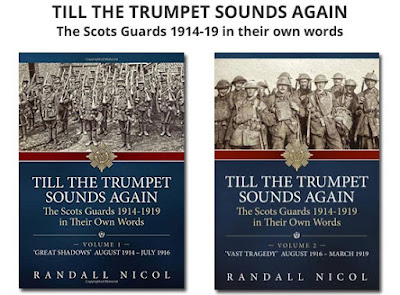
Superb two-volume Scots Guards history massively discounted

 Till the Trumpet Sounds Again


Naval and Military Press has acquired copies of this recent two-volume Helion publication and is massively discounting from £75 to £30. I remember reviewing these books last year (and frankly, it seems a little early to be remaindering these, if this is what has happened) and they are superbly well-researched and very readable.

 Scots Guards

Randall, as former Scots Guards officer himself, knows the regiment well and has access to thousands of Scots Guards service records and other regimental material that he has used unsparingly in this massive two-volume account. At £75 the books were something of a bargain. Now, at £30, these books are no less than a steal ands to be recommended not only to Scots Guards medal collectors and enthusiasts, but to anyone with an interest in the First World War. This is the First World War regimental history that the Scots Guards never had and once these books are sol they will quickly become highly and deservedly sought-after.

 Scots Guards


20 December 2016

Philip Burman RIP


Very sorry to see that Philp Burman died on the 13th December at the age of eighty-four. I never met him but I have bought medals from him and he was well respected in the medals trade.  The photo on this post appears on Philip's site - http://www.military-medals.co.uk/ - which notes that the business has been closed until further notice. RIP Philip Burman.

29 May 2016

9738 Pte Richard Watling, KOYLI


I picked up another 1914 Star trio PoW group this morning to 9738 Pte Richard Watling, King's Own Yorkshire Light Infantry. There's plenty of research potential here, particularly as Richard's group also came with his son's Second World War medals.

Richard Watling was born in Heigham, Norwich on the 3rd February 1888 and joined the King's Own Yorkshire Light Infantry on the 11th June 1908. He was the son of William and Elizabeth Watling and by 1891 was the second youngest of seven children.

He entered France with the 2nd KOYLI on the 14th August 1914 and, according to his entry in the 1914 Star medal roll, was captured on the 30th December 1914. This is clearly incorrect as he appears on my Princess Mary tin database of men captured up to and including the 25th December 1914 and, furthermore, was reported as missing in The Times list published on the 26th October. He was certainly held at Sennelager PoW camp for some of his time in captivity and was repatriated in 1918, arriving at Hull on the 27th November. He was discharged on the 23rd March 1919.

By the time the 1939 Register was taken, Richard was living with his wife Maud (nee Parker) and two sons, Richard Herbert Arthur Watling (1920-1985) and Reginald D Watling (1924-1991) at 19 Salford Street, Norwich.

Richard Watling died on the 3rd May 1964 at the age of 76, probate of £1184 being granted to his son, Richard, insurance agent. At the time of his death his home address was recorded as 17 Woodcock Close, Norwich.

6 March 2016

Loved to death, battered, brooched


Sold today on eBay, this Indian Mutiny Medal and sometime brooch, originally awarded to Robert Smith of the 71st Highlanders. It was sold for £125, a bargain to some and a waste of £125 to others, depending on where you sit when it comes to medals that have obvious damage and/or a history.

I was watching this, interested as much as anything, to see what the final price would be. I like the medals I buy to be in as good a condition as possible and so I don't have obviously damaged medals in my collection. Nevertheless, I can see the merits of buying medals like this one, although I would probably have preferred to purchase it in its secondary brooched status. These re-purposed medals are not uncommon and have the advantage of being, for the most part, quite reasonable to acquire. I suppose an undamaged Indian Mutiny Medal to this regiment would fetch around £400, but I quite like Victoria's facial scars, and the impressed naming in the usual roman capitals, is both lovely and unblemished.


All in all then, I would say that this is a good buy, although I can't imagine that researching the recipient, Robert Smith, will be an easy task.


25 October 2015

1914 PoWs - lists for sale


I have started selling transcriptions of my lists of men who were captured prior to December 1914. You can read more about this project on my 1914 PoWs page. Rolls cost from £10 each; a bargain really when you consider how much information there is on many of them. I have published partial information for some of the regiments; full list follows. Drop me a line for more information.

I can't recall now, from where I obtained the photograph of Pte James Mowat of the 1st Gordons (above). My apologies if I have infringed any copyright.

Royal Artillery
Royal Garrison Artillery
Royal Field Artillery

Household Cavalry

1st Life Guards
2nd Life Guards
Royal Horse Guards (The Blues)

Line Cavalry

3rd (King's Own) Hussars
4th (Queen's Own) Hussars
7th Hussars
8th Hussars
10th (PWO) Hussars
11th (Prince Albert's Own) Hussars
13th Hussars
14th (King's) Hussars
15th Hussars
18th Royal Hussars (Queen Mary's Own)
19th Hussars
20th Hussars

1st (King's) Dragoon Guards
2nd Dragoon Guards
3rd Dragoon Guards
4th Dragoon Guards
5th Dragoon Guards
6th Dragoon Guards
7th Dragoon Guards

1st Dragoons
2nd Dragoons
5th Dragoons
6th Dragoons

5th Lancers
9th Lancers
12th Lancers
16th Lancers
17th Lancers

Foot Guards

Grenadier Guards
Coldstream Guards
Scots Guards
Irish Guards

Infantry (Line and Territorial Force)

Argyll & Sutherland Highlanders
Bedfordshire Regiment (173 named individuals)
Black Watch (Royal Highlanders) (53 named individuals)
Border Regiment
Buffs (East Kent Regiment)
Cameron Highlanders
Cheshire Regiment
Connaught Rangers
Dorsetshire Regiment (390 named individuals)
Durham Light Infantry (184 named individuals)
East Lancashire Regiment
East Surrey Regiment
Essex Regiment (44 named individuals)
Gloucestershire Regiment
Gordon Highlanders (806 named individuals)
Hampshire Regiment
Highland Light Infantry
King's (Liverpool Regiment)
King's Own (Royal Lancaster Regiment) (221 named individuals)
King's Own Scottish Borderers
King's Own Yorkshire Light Infantry
King's Royal Rifle Corps
Lancashire Fusiliers
Leicestershire Regiment
Leinster Regiment
Lincolnshire Regiment
London Regiment (Territorial Force)
Loyal North Lancashire Regiment (509 named individuals)
Manchester Regiment
Middlesex Regiment (397 named individuals)
Norfolk Regiment (215 named individuals)
North Staffordshire Regiment
Northamptonshire Regiment
Northumberland Fusiliers (152 named individuals)
Ox and Bucks Light Infantry
Queen's (Royal West Surrey Regiment) (425 named individuals)
Rifle Brigade (304 named individuals)
Royal Berkshire Regiment
Royal Dublin Fusiliers
Royal Fusiliers (247 named individuals)
Royal Inniskilling Fusiliers
Royal Irish Rifles
Royal Munster Fusiliers
Royal Scots
Royal Scots Fusiliers
Royal Sussex Regiment (26 named individuals)
Royal West Kent Regiment (158 named individuals)
Scottish Rifles
Seaforth Highlanders
Sherwood Foresters
Somersetshire Light Infantry (186 named individuals)
South Lancashire Regiment (342 named individuals)
South Staffordshire Regiment
South Wales Borderers
Suffolk Regiment (621 named individuals)
Wiltshire Regiment (686 named individuals)

Other Corps

Army Service Corps
Military Mounted Police
Royal Army Medical Corps
Royal Army Ordnance Corps
Royal Engineers

Royal Navy

23 May 2015

A Pozieres MC

 
New items from the London Medal Company this week in include this fine group to a Royal Fusiliers officer who had previously served in the ranks of the Lincolnshire Regiment during the Sudan and Second Anglo-Boer war campaigns. It would look great on my wall.


10 May 2015

Beware "low number" hype


Medal dealers love to highlight low regimental numbers as indication of long service or original battalion membership. For that matter, there are also collectors who only collect low regimental number medals to particular regiments or corps.

In the example below, the low number 35 is singled out as being worthy of note. But is it really that remarkable? The Rifle Brigade, alone of all the infantry regiments, did not start a new number series in 1881 but continued merrily along its way with its existing series.  And why shouldn't it have done so? It was unaffected by Cardwell's changes and there was really no need to start afresh. It was numbering in the 4000s by July 1881, reached 9999 in 1889 and started a new number series in February that year. It reached 9999 for a second time in late 1903 and started again from 1 either very late 1903 or on the 1st or 2nd January 1904.


So in the case above, the number 35 does not signal that the man was an original member of a particular battalion (or regiment). He simply happened to enlist at a time when the Rifle Brigade had just started a new number series commencing from 1.

This man was a regular, career soldier, and as a general rule, the majority of Territorial Force units did start numbering from 1 when the TF came into being in 1908. In the same way, the majority of Special Reserve units did not start numbering from 1 when they replaced the militia in 1908.  So low TF numbers might indeed signal early entry into a particular unit (and often prior service in the Volunteer Force). However, there are significant exceptions to the rule in both cases, some of which I have unpicked, and continue to unpick, on my army service numbers blog.

Images courtesy of the London Medal Company.

23 March 2015

21 February 2015

London Medal Company - New stock


Some attractive medals have just been added by the London Medal Company. There is a range of items and with a range of prices to match. Great War pairs from £40. Worth checking out.

Pictured above, the group of 3: Campaign Service Medal 1962, 2 Clasps: Northern Ireland, Air Operations Iraq; (24428535 PTE M R ATKINS GORDONS); Jubilee Medal 2002; Accumulated Campaign Service Medal, 1st type; (24428535 SGT M R ATKINS R ANGLIAN), mounted court style as worn.

8 February 2015

DNW - Orders, Decorations & Medals - 25th Feb 2015

 
The latest Dix Noonan Webb beanfeast kicks off on 25th February at 10am. Lot 594 (above, estimate £2000 - £2500) is one of currently 847 lots in total. Browse or download the catalogue by clicking on the link. Image courtesy of DNW.


29 January 2015

Neate auctions


From Neate auctions:

Auction 180 ends this Sunday 1st February 2015.  Auction 181 has been added to the site.

Both auctions can be viewed at 
www.neateauctions.co.uk.  On the home page please click on the categories tab to view all current lots.

As previously announced, Auction 182, which will commence on 26th February 2015 and conclude on 29th March 2015, will be Neate Auctions final sale.  Neate Medals will continue to operate as normal.  Our retail site can be found at
www.neatemedals.co.uk

So there you have it.  Image courtesy of Neate Auctions. Medals to 4215 Pte William Wallbank, 38th Foot.

7 December 2014

France and Germany Star


Qualification:
Awarded for service in Belgium, France, Germany and Holland between 6th June 1944 and 8th May 1945.

For the Royal Navy and the Merchant Navy, there was no prior time qualification. To qualify, personnel must have been "afloat in direct support of operations in the named countries above "... in the North Sea south of a line from the Firth of Forth to Kristiansand, in the English Channel or the Bay of Biscay east of longitude 6 degrees west." Personnel serving onshore in support of land operations also qualified but those serving off the south coast of France qualified for the Italy Star instead.

For the Army, participation in any operation on land in Belgium, France, Holland or Germany.

For the RAF, any service over Europe between 6th June 1944 and 8th May 1945 except those which started from the Mediterranean and qualified for the Italy Star. Non aircrew qualified under the same conditions as the army.

The France and Germany Star was not awarded in addition to the Atlantic or Air Crew Europe Star. Those who qualified for the Atlantic Star, Air Crew Europe Star or France and Germany Star were only awarded the star for which they qualified first, and a clasp for the second. A second clasp was not awarded to those who qualified for all three stars.

Description:
Bronze, 43mm diameter six-pointed star. The Royal cypher GRI with the roman numerals VI below. The cypher is surmounted by a crown and within a circlet which reads, THE FRANCE AND GERMANY STAR. All the Second World War Stars were designed by The Royal Mint.

Ribbon:
32mm wide in equal strips of blue, white, red, white, blue; these colours representing the flags of the United Kingdom, France and Holland. This ribbon, in common with all WW2 Star ribbons, was designed by His Majesty the King, King George VI.

Suspension:
A ring attached to the uppermost point of the star.

Naming:
Issued unnamed although some stars may have been privately engraved.

Clasps:
One: Atlantic. This was awarded to men who qualified for the France and Germany Star followed by the Atlantic. When the ribbon alone was worn, a silver rose emblem fixed to it noted the award of a clasp.

No Air Crew Europe clasp was awarded with this medal.

Acknowledgements:
Photo courtesy of The Cameronians. Text assistance from British Battles & Medals.

29 November 2014

Coorg Medal


Instituted:
1837

Qualification:
Awarded by the Honourable East India Company to Coorg soldiers who remained loyal during the Canara uprising.

Description:
Issued in gold (44 examples) and silver (300); 50mm in diameter and of varying thicknesses.

Obverse:
A Coorg warrior with his knife raised aloft in his right hand and a musket in his left hand. The Canarese inscription around the edge translates as, A MARK OF FAVOUR GIVEN FOR LOYALTY TO THE COMPANY'S GOVERNMENT IN SUPPRESSING REBELLION IN THE MONTHS OF APRIL AND MAY 1837.

Reverse:
Knives and war trophies within a laurel wreath and the inscription, FOR DISTINGUISHED CONDUCT AND LOYALTY TO THE BRITISH GOVERNMENT. In the exergue, COORG, APRIL 1837.

Ribbon:
There was no ribbon. Medals awarded to officers were suspended from chains, those to other ranks from cord. The swivelling suspension and ribbon buckle in the example above were obviously added later (along with the ribbon).

Suspension:
A plain loop as illustrated at the top of this post.

Naming:
Issued unnamed.

Clasps:
None issued.

Acknowledgements:
Dix Noonan Webb for the two images from past auction sales; British Battles and Medals for the background.

23 November 2014

Imperial British East Africa Company Medal


Qualification:
Initially awarded for bravery and later, after the company ceased to exist, claims made on the basis of campaign service.

Description:
The Imperial British East Africa Company received its charter in September 1888 and was wound up in October 1895. The following campaigns were in the company's jurisdiction:

1. Campaign against the sultan of Witu (1890)
2. Uganda Religious War 1891-92
The medal is 40mm, made of silver and extremely scarce. There are only 29 confirmed medals and post 1895 authorisations.

Obverse:
The company's arms of a crowned sun and ascroll underneath with the motto, LIGHT AND LIBERTY. The Arabic inscription beneath that translates as 'The Reward of Bravery'. Around the outer edge, the name of the company: THE IMPERIAL BRITISH EAST AFRICA COMPANY.

Reverse:
Plain, except for a lotus flower wreath.

Ribbon:
Plain blue

Suspension:
A plain ring suspender (above) or a swivelling scroll suspender (below).


Naming:
Engraved on the edge or the reverse.

Clasps:
None issued.

Acknowledgements:
Dix Noonan Webb for the two images from past auction sales; British Battles and Medals for the background. 

16 November 2014

Seringapatam medal


Qualification:
Awarded to men who contributed to the British victory in the 1799 Battle of Seringapatam against the armies of Tipu Sultan. The medal was commissioned by the East India Company in 1801 but the Company's officers di not receive Royal sanction to wear the medal until 1815, whilst officers of the British Army did not receive permission until 1851.

Description:
Minted in gold, silver-gilt, silver, bronze and pewter. The majority of the medals were struck at the Soho Mint in Birmingham but some inferior Calcutta strikings of the gold medal (83 examples) and silver medal (2,786 examples) were minted in 1808 and awarded to native officers (gold medals) and native other ranks (silver). This went against the guidance for the issue of medals from the English mint.


English medals were 48mm in diameter whilst the Calcutta medals were 45mm in diameter. The two strikings also differ in that the English version carries the designer's initials CHK above and to the right of the exergue (see above detail from a gold medal) whilst the Calcutta version has the initials in the wrong order - CKH - and the letter K reversed (see silver medal example below).


Obverse:
The British lion triumphing over Tipu Sultan's tiger. The Arabic inscription in the pennant translates as The Victorious Lion of God. The date given in the exergue is IV MAY MDCCXCIX

Reverse:
A scene of the attack on the fortress of Seringapatam. The Persian inscription underneath translates as Seringapatam God given 28th day of the month Zikadah, 1213 of the Hegira.

Ribbon:
Pale watered orange, 38mm wide, but also commonly seen with the same ribbon as that used for the Peninsular Gold Medal.

Suspension:
Issued without suspension but found with various types subsequently added.

Naming:
Issued un-named, although some later engraved by the recipients.

Clasps:
None, although some medals have clasps added which bear the text, SERINGAPATAM.

Acknowledgements Dix Noonan Webb for information from past auction sales and the images which I have reproduced on this post.

24 October 2014

Medals in marble


This beautifully executed memorial is one of many in Canterbury Cathedral. It was dedicated by the wife of Major General Henry Richard Abadie CB, formerly of the IX (Queen's Royal) Lancers, in memory of her husband and four sons who died in the service of their country.


23 October 2014

Dix Noonan Webb - 24th October 2014


The latest DNW medal fest kicks off tomorrow with the auction of British Orders and Medals formed by the late Fred Rockwood. The usual deep pockets will be required. Dix Noon Webb auction catalogue here.

21 August 2014

Reeman Dansie - militaria auction 28th August


Lot 487 (above) also includes a death plaque. The soldier, 301617 Rifleman William Frederick Tindley of the London Rifle Brigade was killed on 1st July 1916 so you can probably add a 0 to the £100-£150 estimate.
 
 
Update 4th September 2014. Hammer price on the above was £620. Add seller's premium of 20% (£124) plus VAT on that (£25) and you get an overall price of  £769.